| Cow Horns have long been employed for making waterproof containers. From the 17th century onward here in North America, powder horns, spice horns, horn cups, horn spoons, horn combs, even schoolbook primers known as horn books were common. However, for many, when a horn container is mentioned, the first image that comes to mind is that of a traditional powder horn. The later half of the 18th century is said to be the Golden Age of powder horn making as an art form here in America. During this time, various artists utilized the horn as a canvas upon which they etched scenes, names, and family crests. Historical events like the dates of battles fought were often inscribed on the sides of horns. These etchings collectively became known as scrimshaw folk art and today, original pieces fetch prices in the hundreds and thousands of dollars, depending upon the name of the artist or the detail and quality of the artwork. Heritage Products is pleased to bring you the unique works of scrimshaw artists from across the country who excel in this art form and craft powder horns, priming horns, spice horns, powder measures, cups, needle cases and other historically-accurate reproductions that can only be described as museum quality. Please take the time to read the brief biographies of each before looking at their work. We think you will find this section particularly interesting. Our artists are: |
|||||||||
|
Orville Mumma lives in Jonestown, Pennsylvania where he reproduces many different Golden Age horn products. Orville is especially fond of reproducing the work of the makers of Pennsylvania, New York and New England and his work is highly sought after by re-enactors and collectors from this region of the country. He enjoys the challenges of making unusual items such as salt and spice horns with turned antler screw tips, horn and bone turkey calls, artillery powder horns, lathe-turned antler needle cases, and flattened priming horns with intricate scrimshaw scenes.
|
|||||||||
 |
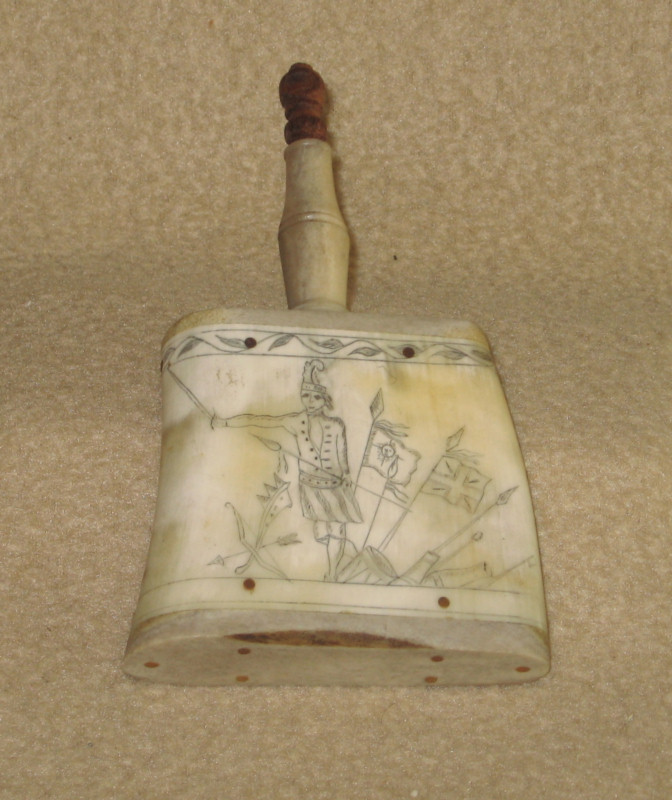
PH-010 Salt Horn Salt was an important ingredient to 18th century cooking – just as it still is today. Many bland dishes can “come alive” with just a touch of salt. The salt horn enabled a hunter, soldier, or adventurer in the wilderness to carry a personal supply of salt which would pour freely even on damp days. This salt horn is made of a flattened cow horn with top and base plugs made from slabs of deer antler. The threaded spout is crafted from a piece of lathe-turned antler and contains a hand carved wood stopper. This is truly a unique item. The scrimshaw rendering is that of a Scottish Highlander in the British Army. $125.00
|
||||||||
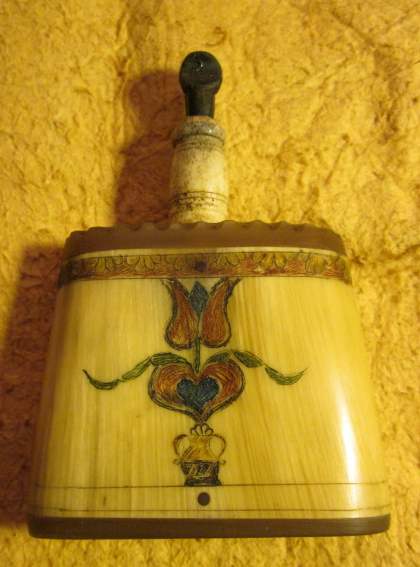
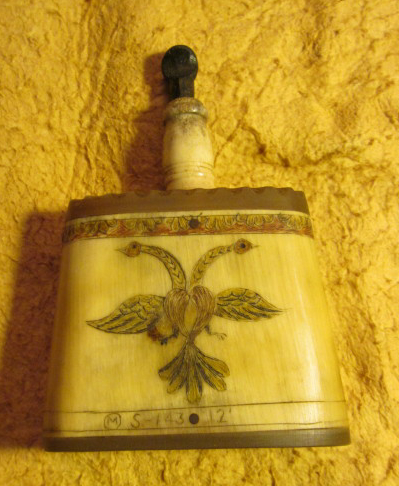
| PH-035 Salt Horn Salt was the ingredient most sought after when on a long hunt or in the home for making tolerable food tasty and appetizing. On the trail a salt horn in the haversack assured the owner of at least making whatever food was found at mealtime full of flavor. In this case, the Salt Horn has scrimshaw on both the front and back of the horn. On the front is a red, green, and black tulip while on the back is a two-headed bird in black and brown. Is this an early American secret Masonic symbol? The turned antler screw tip is easy to screw out for filling the horn with salt or whatever spices you might want to carry in it. $90.00
|
 |
||||||||
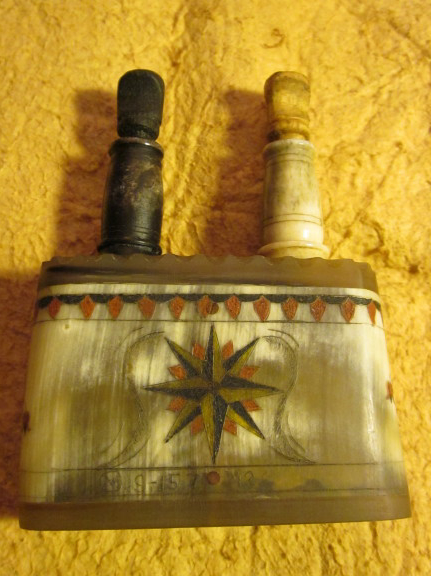 |
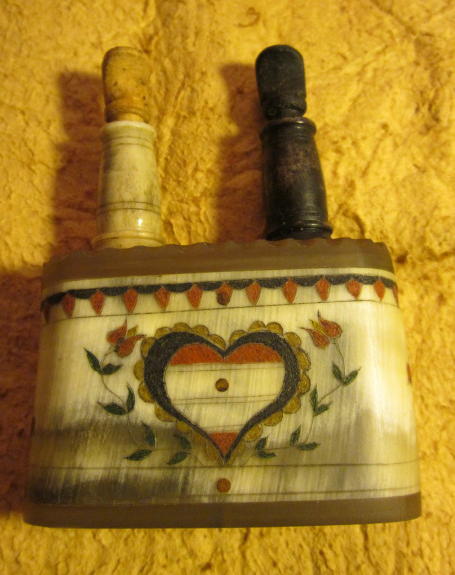
PH-036 Spice Horn This finely crafted Spice Horn has what it takes to become a treasured family heirloom one day. The front of the horn has an engraved heart with blank lines for you to add your name or date. The interior of the horn has been divided into two compartments for you to carry two spices or salt and pepper. The antler tip pouring spouts have coarse threads on their bases to make filling the horn an easy task. The back of the horn has been embellished with a very classic compass rose. The top plate of the horn has been engrailed and both sides have flowering vines decorating the horn. All in all, a very nice Spice Horn. You will enjoy flavoring your food with this Spice Horn – but will take greater pleasure when your friends ask to use it when you have all gathered to share a meal. $100.00
|
||||||||
| SH-001 Antler Tip Powder Measures Each of these powder measures are one-of-a-kind and differ in size and style of decoration. Amounts of FFg black powder vary and range from 20 to 120 grains. Each are similar in that they are all carefully crafted and each has a pour spout at the mouth of the measure which makes it that much easier to pour into the muzzle of pistol or long gun. Please indicate the size of charge needed. $25.00 | 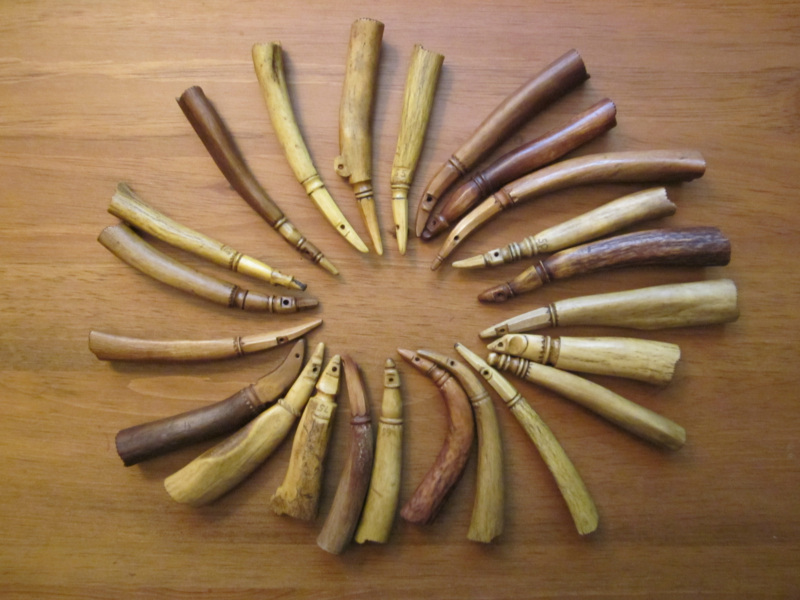 |
||||||||
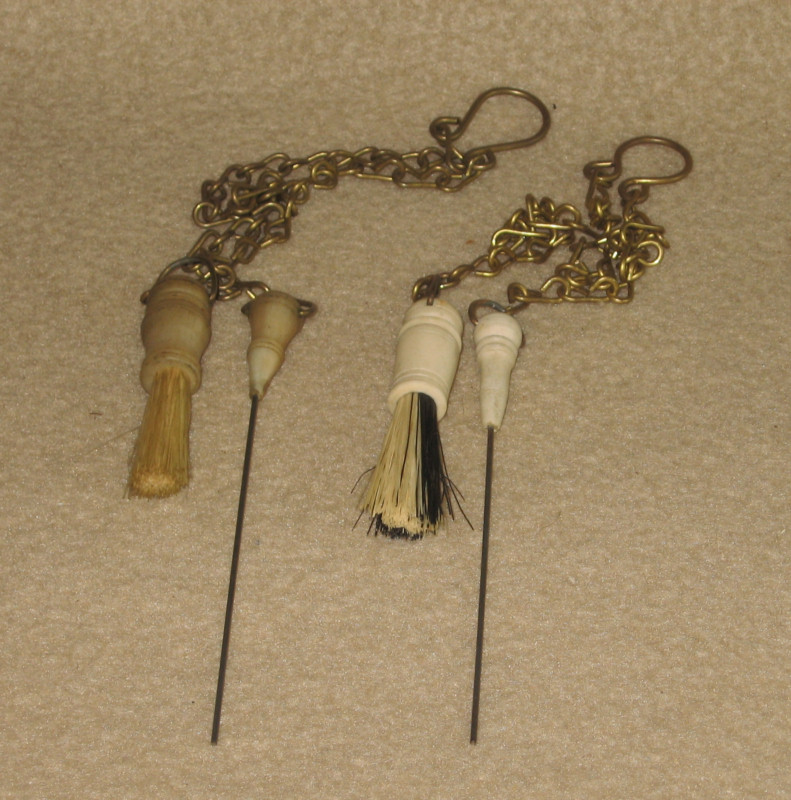 |
PH-012 Whisk and Pick Set This set of simple tools is designed for keeping the pan and the vent hole of the flintlock mechanism clean and clear of powder residue and fouling. Nothing is more frustrating than concentrating on making that “perfect bull’s eye” and then have the flintlock misfire! This set is made of turned deer antler or turned cow horn, fitted with all natural bristles in the brush and steel piano wire in the pick. The handles are left unstained as the natural oils from the user’s hands will quickly stain these pieces with a unique patina. $20.00 per set | ||||||||
| PH-034 Horn and Antler Vent Pick If you have a notion to spruce up your shooting bag this season, this might just be what you are looking for. This work of art does double duty as a vent pick. The back of the case that holds the pick has been drilled for you sew it onto the shoulder strap of your shooting bag at whatever height bests suits your needs. Rest assured that not many shooters you compete against this season will have such a fine-crafted pick. $40.00 | 
|
||||||||
Prime Horn Selection
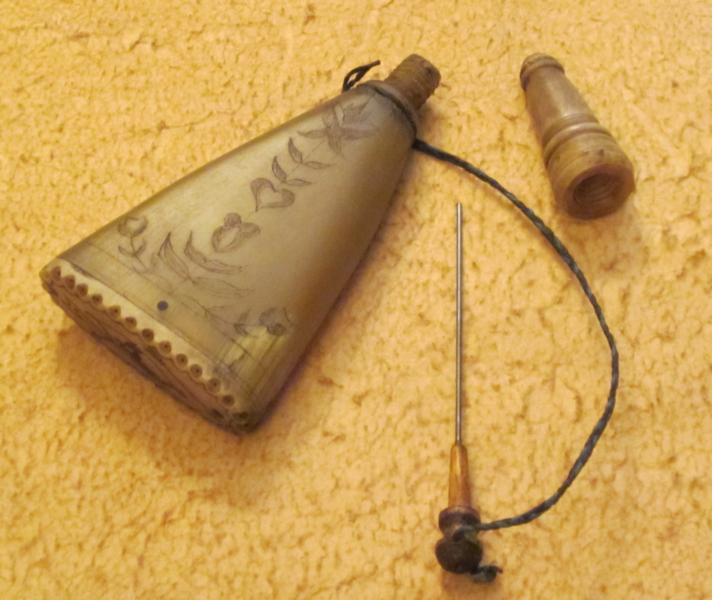
| PH-029-1592 Tan Horn, Scrimshaw Both Sides This Prime Horn has a screw tip of cow horn and a base plug of deer antler. The base plug has been decorated with engrailing around the perimeter and scrimshaw across the flat field. Both sides of the body of the horn have been decorated with typical 18th century scrimshaw patterns.The stopper has been fitted with a vent pick
$110.00
|

 |
||||||||
 |
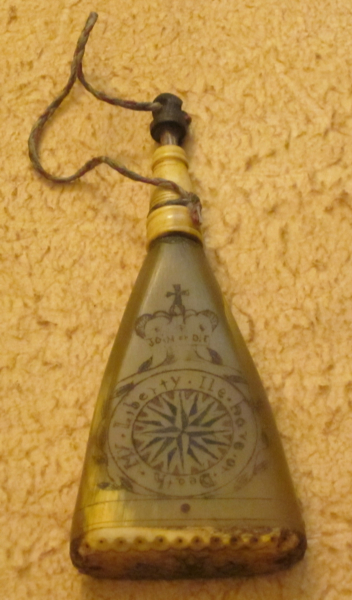
PH-030-1689 Prime Horn with Scrimshaw 'Join or Die' This very nice prime horn has scrimshaw inscriptions that read "Join or Die" across the top while the words "My Liberty Ile Have or Death" encircle a compass rose. These are all popular motifs of the Revolutionary War period and bespeak the mind of the American Patriot. This horn, in its own right, is sure to become a treasured heirloom one day.
$115.00
|
||||||||
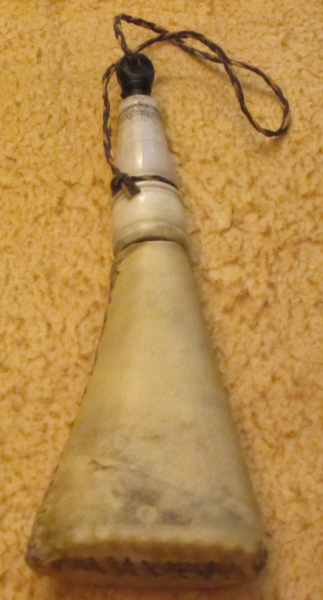
| PH-031-1735 Leather Covered Prime Horn This one of a kind prime horn has a turned deer antler tip pinned in place while the horn itself is leather covered, making it a very unique horn. As it is used, the natural oil in the user's hands will darken the leather creating an aged patina.
$95.00
|

 |
||||||||
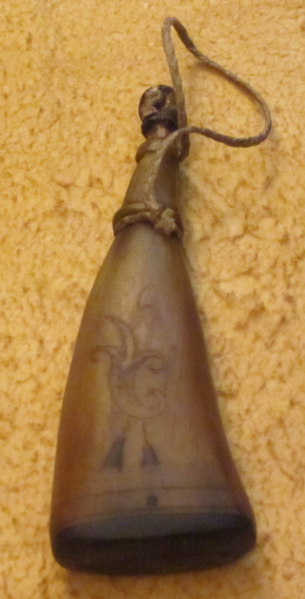 |
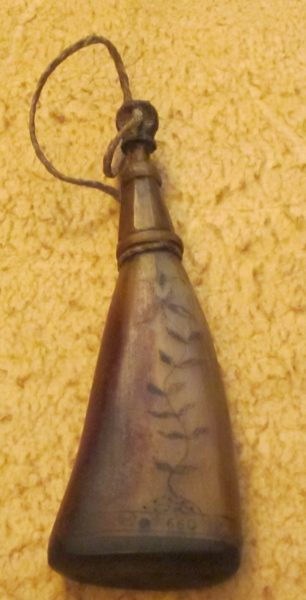
PH-032-1660 Prime Horn with Floral Scrimshaw This prime horn exhibits period scrimshaw on both sides - on the front side is a floral pattern of vines and leaves while the revers side has a martial pattern of arrows and halberd.
$90.00
|
||||||||
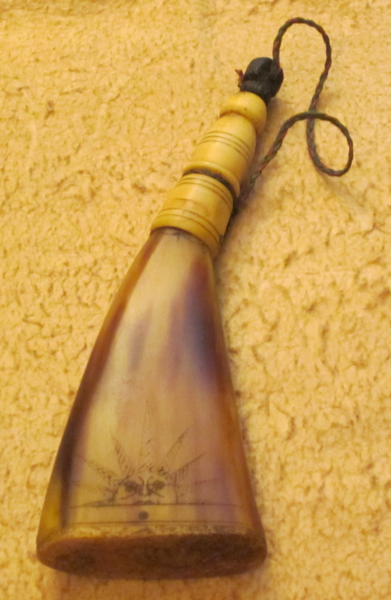
| PH-033-1733 Tan Horn with French Sun This prime horn has a spout of turned deer antler that has been staked to the body of the horn with a wooden peg. The scrimshaw is that of the French Sun King and is typical of art from the French & Indian War. The spout has been lightly stained to blend with the colors of the horn, giving the appearance of aged ivory. overall, this is a very fine horn that will become an old friend in short order.
$95.00
|
 |
||||||||
And, the following Shipping Charges will be automatically added to each order at check-out.